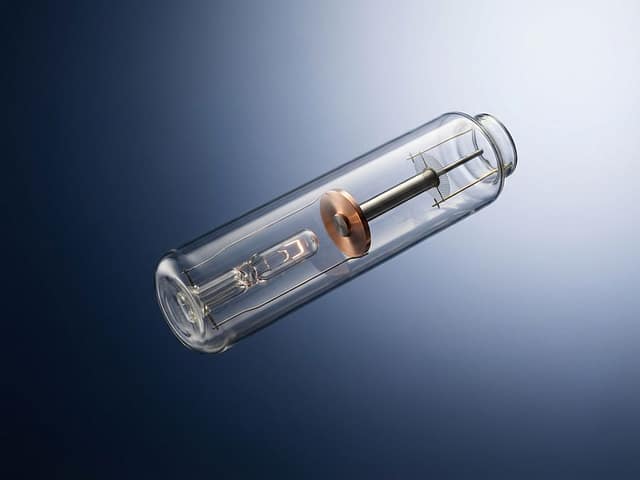
X-ray tubes contain a few main components: the cathode (which produces electrons), the anode (which creates X-rays when electrons hit it), protective housing with lead shielding, and cooling systems. These medical X-ray tubes work together to convert electrical energy into the X-ray radiation needed for diagnostic imaging in hospitals and clinics worldwide.
What is an X-ray tube?
An X-ray tube serves as the radiation source for X-ray imaging systems, converting electrical energy into X-ray radiation that can pass through tissue with different tissues absorbing varying amounts of radiation to create the contrast visible on medical images. These diagnostic images enable doctors to visualize bone fractures, detect pneumonia, and perform medical procedures that support patient diagnosis.
Medical X-ray tubes operate at high voltages, typically between 40,000 and 150,000 volts, which allows them to produce X-rays with sufficient energy to penetrate human tissue.
What are the two main parts inside every X-ray tube?Every X-ray tube contains two primary components: the cathode (negative electrode) that produces electrons, and the anode (positive electrode) that creates X-rays when those electrons strike it. These two parts work together inside a vacuum-sealed glass or metal housing to generate the X-ray radiation needed for medical imaging.
The cathode acts as the electron source, heating up to release a stream of electrons through a process called thermionic emission. Meanwhile, the anode serves as the target, made from materials like tungsten that can withstand electron bombardment while producing X-rays efficiently.
The cathode directs electrons across the vacuum space, and when these high-speed electrons impact the anode, they convert their kinetic energy into X-ray photons. This electron-to-photon conversion enables X-ray imaging.
How does the cathode create the electron stream?
The cathode creates electrons through thermionic emission, where an electrical current heats a thin tungsten filament to approximately 2,000°C, causing it to release electrons. A focusing cup surrounding the filament then shapes these electrons into a precise beam directed toward the anode.
The process occurs when electrical current flows through the tungsten wire, heating it until electrons gain sufficient energy to escape from the metal surface. Higher filament temperatures result in increased electron emission.
The focusing cup controls beam quality. This cup-shaped electrode surrounds the filament and uses its negative charge to concentrate the electron stream into a focused beam. Without proper focusing, the electrons would scatter in multiple directions, creating image degradation and energy loss. Most modern X-ray tubes have dual filaments of different sizes, allowing technicians to select between fine or broad electron beams depending on the imaging requirements.
What makes the anode so important in X-ray production?
The anode converts electron energy into X-rays when high-speed electrons strike its tungsten target surface. Most modern medical X-ray tubes for OEM imaging use rotating anodes that spin at 3,000–10,000 RPM to distribute heat across a larger surface area, preventing damage from electron bombardment.
Tungsten functions as an effective anode material because it has a high atomic number (74) and a high melting point (3,422°C). When electrons impact tungsten atoms, they produce both X-rays and heat. Approximately 1% of the electron energy becomes useful X-rays, while the remaining 99% of the energy that converts to heat must be managed.
Rotating anodes address the heat management requirement. Instead of electrons hitting the same location repeatedly, the spinning motion distributes the impact across a circular track on the anode disc. This allows the tube to handle higher power levels and produce more X-rays without overheating. Some high-performance CT tubes can handle power levels exceeding 100 kilowatts, enabling rapid imaging sequences.
What protects everything inside the X-ray tube housing?
The protective housing surrounds the X-ray tube with lead shielding to contain radiation, cooling systems to manage heat, high-voltage insulation for safety, and vacuum seals to maintain the electron path. This housing protects both patients and operators while ensuring consistent tube performance.
Lead shielding forms the primary safety barrier, absorbing stray X-rays that don’t contribute to image formation. The housing typically contains several millimeters of lead-equivalent material, with a small window that allows the useful X-ray beam to exit while blocking radiation in all other directions.
Cooling systems prevent tube damage from heat buildup. Most housings contain oil that circulates around the tube, absorbing heat and transferring it to external heat exchangers. Some high-performance systems include active cooling with pumps and fans.
How do all these X-ray tube components work together?
The complete system works in sequence: electrical current heats the cathode filament, releasing electrons that accelerate toward the rotating anode, where they produce X-rays that pass through the housing window to create medical images. Each component must function properly for the X-ray tube to produce diagnostic-quality images.
The process begins when the X-ray technician selects exposure settings on the control panel. High voltage (typically 80–120 kV for diagnostic imaging) accelerates electrons from cathode to anode, while tube current (measured in milliamperes) determines how many electrons flow per second. The exposure time controls how long this process continues.
How Varex Imaging helps with X-ray tube technology
We provide comprehensive X-ray tube solutions that help medical equipment manufacturers create reliable, high-performance imaging systems. Our expertise spans the complete range of tube technologies, from standard diagnostic tubes to advanced CT systems that serve hospitals worldwide.
Our X-ray tube offerings include:
- High-performance rotating anode tubes for demanding clinical applications
- Specialized CT tubes designed for rapid, high-resolution imaging
- Advanced cooling systems that extend tube life and improve performance
- Custom tube designs tailored to specific imaging requirements, including industrial X-ray tubes for non-medical use
- Comprehensive support services, including replacement X-ray tubes for existing systems, to help manufacturers optimize their systems
Ready to learn more about how our X-ray tube technology can enhance your imaging systems? Visit our main site to explore our complete range of medical imaging components.